tiistai 9. lokakuuta 2012

The law of calorie balance - numbers behind fat loss


"Any discussion about optimal calorie intake is really a total waste of time - unless you are actually
counting the calories! Unless you have done this in writing, and over a significant period of time
(4-12 weeks), any discussion of this nature is purely academic. Don't kid yourself - get out your
diary, buy a calorie/nutrient counter book and do yourself a favor; get to really know what you are
doing - and more importantly - what the result of this specific combination is."


The Definition of a Calorie


You may hear many people talking about calories all the time, but when you would ask them to
explain exactly what a calorie is or tell you how many calories they consume and burn every day,
they wouldn’t have a clue. During this week, I will try to explain exactly what a calorie is , and
hopefully you too will be an expert on calories. You will learn exactly what calories are, how they
are stored in your body, how many you burn every day and how many you should eat to lose body
fat without losing muscle mass.

I’ll show you why it's important to count calories and you’ll learn  why guessing or counting only
some portions might be the only thing preventing you from getting fitter. I’ll also introduce you to
a simple method you can use to make calorie counting a quick and easy process. Best of all, I’ll
tell you the single most powerful method for fat loss ever developed. So let’s get started!


Let's begin with the definition of a calorie: The technical definition of a food calorie (kilocalorie) is
the amount of heat required to raise 1 liter of water 1 degree Centigrade. A calorie is simply a
measure of heat energy. When food is heated, it releases a certain amount of heat (energy),
depending on the type of food. The more calories that are in a food, the more energy will be
released when it is burned in your body. The word “calorie” is used interchangeably to describe
the amount of energy in food and the amount of energy stored in the body as body fat and glycogen
(stored carbohydrate).


Body fat is like a reserve storage tank for energy. When we speak of “burning off body fat” we
are talking about releasing calories from your reserve storage tank and burning them to fuel your
training. If you don't do any activities, the body fat just sits there in storage until you need it. If you’re
an average 85kg man with about 18% body fat, you have 15,3 kgs of adipose tissue. There are
about 7700 calories in each kg of body fat, which adds up to a total of 117,810 calories of reserve
energy in storage - enough to last you a long time!


Such a large calorie reserve, combined with the body’s starvation response, explains why you can
stay alive for so long without food (as long as you get water). Fasting has been studied extensively
and there are many documented cases of people living for months without eating any food whatsoever.

Your energy reserves served an important evolutionary purpose thousands of years ago, but
nowadays only very small amounts of body fat are essential for health. In our modern society
where famine is no longer the concern it was for our ancestors, body fat is today like an annoying
cosmetic problem (and a major health risk for some people).

Thanks to tens of thousands of years of evolution, you’ve developed a body that is an incredibly
efficient fat-storing machine. That’s the bad news. The good news is, by understanding calories
and balancing your input with your output, you can easily lose fat and maintain a healthy and attractive
body fat ratio.


The calorie bank analogy


A good analogy is to think your body as a calorie bank and caloric energy as money. You store
calories in your body like you store money in a bank. You can make energy deposits (eating)
and withdrawals (exercising) from your body like you would make money deposits and withdrawals
from the bank, depending on how high your energy costs are (but to the contrary of real banking,
in this case the withdrawals are the preferred option :P).

When your energy costs are the same to the calories you consume, then all the calories you consume
are burned immediately and no deposit or withdrawal of calories takes place - your balance stays
the same. When your energy costs are greater than the number of calories ingested, you will make
an energy “withdrawal” from your calorie bank and your body fat “balance” will decrease.  And
then again if your energy costs are less than the amount of calories you ingest, then you will make
an energy “deposit” and your body fat “balance” will increase (excess calories go into fat storage).


The exception to this rule is when you are on a weight training program to gain muscle mass. In that
case, a small part of the calorie surplus is directed into muscle growth. But even when you’re training
hard, if the calorie surplus is too big, the excess beyond what is needed for muscle growth will go straight into fat storage.


The reason why calories do count!


From these basic explanations, you can now easily recognize the importance of counting calories.
Keeping track of calories is just as important as keeping track of the money traffic on your bank
account. If you fail to pay attention to your finances and you make more withdrawals than deposits,
soon enough you'll find yourself being broke. It's the same with calories, except the reverse is true:
If you don’t keep track of your calorie deposits, you’ll soon find yourself with an overstuffed calorie
account in the form of unwanted body fat!


Despite the importance of watching your calories, many diet programs claim that calories don’t matter
as long as you eat the right “secret mixes” of foods. For example, in 1961, a book called "Calories
Don't Count" was published by Dr. Herman Taller. The program was one of the first to promote high protein, very low carb diets (VLCDs). Others followed, the most popular of which was “Dr. Robert
Atkin's New Diet Revolution.”


The general denominator in most of these VLCDs is the claim that by removing most or all of the carbs,
you can eat an unlimited amounts of protein and fat sourced foods. This is where the phrase “calories
don’t count” came from and that’s why you may hear about this idea little too often.

Unluckily, the concepts of eating unlimited anything or of calories “not counting” are 
dead wrong! According to the “calories-don’t-count” theory, if you eat certain foods, or certain combinations of foods, you can eat as much as you like and you’ll still lose body fat. Of course,
in our lazy and pleasure-seeking society today, this idea sounds wonderful, but it's physiologically
impossible. The reason you lose weight on VLCDs without setting calorie limits or requiring calorie
counting is because they reduce appetite and cravings.


Those diets allow you to eat more fat, which makes you feel full sooner. You also tend to get fewer
cravings because eating fat and protein in the absence of carbohydrates keeps your blood sugar and
insulin levels stabile. The end result is that you automatically eat fewer calories. The weight loss
experienced on these programs in reality comes from a calorie deficit, not from any “magical” effect
of the diet itself.

If you were to follow a Very Low Carb Diet, but you consumed more calories than you burned up
during the day, you would still gain body fat. The often-made claim, “Eat all you want and still lose weight,” is one of the biggest and most common lies told in the weight loss industry!


maanantai 8. lokakuuta 2012

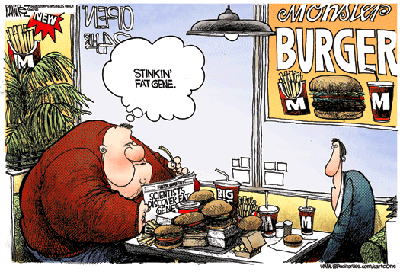
10 major genetic differences affecting fat loss, fitness, muscle gain and athletic performance


There are 10 major genetic variables that affect your ability to lose body fat, build muscle,
increase strength and reach high levels of athletic potential. Looking into these variables
will give you a better understanding of how nutrition and training can affect each of us
differently.


1. Muscle insertions


The muscles insert onto the same bones in all of us; however, the exact point of insertion is
what varies. Even a little difference in insertion points can create a rather big increases in
mechanical advantage. This partly explains why certain people are naturally stronger than
others (they have better leverage because their muscle insertion points are further from
the origin points.)


2. Number of fat cells


You were born with a predefined number of fat cells. Some people are born with more
than others. The person born with more fat cells has a disadvantage compared to someone
with fewer fat cells. The number of fat cells can increase throughout life but it can't decrease
(except through liposuction, which has many possible dangers). Fortunately for us, what can
change is the size of those fat cells. Even someone with a large number of fat cells can shrink
all of them, thereby still able to be very fit and lean!


3. Digestive capabilities


Some people have a very efficient digestive system capable of greater absorption and utilization
of foods nutrients from the digestive tract. The length of the intestinal tract may also vary by as
much as 4,5 meters or more among the various body types!


4. Limb lengths


Some of us were born with longer legs and longer arms, others with short legs and short arms.
Your limb length may affect the way your body’s symmetry appears and it may also affect your
strength, athletic performance and ability to build muscles. Longer limbs means longer levers,
which can possibly create a mechanical disadvantage when performing some certain exercises.
Some people were blessed with ideal leverage and that’s why they happen to be naturally strong.


5. Basal metabolic rate


Your basal metabolic rate (BMR) is the amount of energy (calories) you burn when resting just
to keep your normal body functions going such as breathing, blood circulation, digestion, thinking,
and such autonomical features. Genetically gifted people are like cars that idle very fast. They burn
off lots of fuel even while sitting still. When they become active, they move fast and burn off fuel at
an enormous rate.


6. Joint circumferences


People can be either large boned, medium boned or small boned. Many people are heard
complaining they are “big-boned,” invoking that as a reason they are overweight. Joint size
affects your body shape, however it has nothing to do with your ability to lose body fat, 
so don't hide behind that as an excuse. A simple test for joint size is to wrap your hand around
your opposite wrist.

If your thumb and middle finger overlap, you are small jointed (usually 15-17,5 cm wrists);
if your thumb and middle finger touch, you are medium jointed (usually 17,5-20 cm wrists); and lastly
if your thumb and middle finger do not touch, you are large jointed (usually 20 cm or more in
wrist circumference).


7. Food allergies and insensitivities


Some people naturally have or acquire food allergies and insensitivities. Lactose intolerance
(an inability to properly digest dairy products) is a known example. Over the years, people
naturally tend to eat certain foods while shying away from others. Some people become
vegetarians while others become carnivores just because of the way each food or diet makes
them feel.


8. Muscle fiber type


Within each person’s predetermined number of muscle fibers, we also have different
types of muscle fibers. Some fibers are suited to endurance sports (red or slow-twitch
fibers) while others are suited for power, strength, and explosive sports (white or fast
twitch fibers). The differences in each person’s ratio of muscle fibers may be the reason
why some people are better endurance athletes while others naturally make the grade at
strength or power sports.


9. Number of muscle fibers


Like fat cells, you were also born with a predefined number of muscle fibers. The process of
breaking down existing muscle fibers into new fibers, hyperplasia, has been hypothesized but
never conclusively proven in humans. If you were born with a large number of muscle fibers,
you will have a greater potential for developing muscle size than someone with fewer fibers.


10. Insulin response and sensitivity to carbohydrates


Some of us are more sensitive to carbohydrates than others. Your level of sensitivity to carbohydrates
will have a direct effect on your ability to lose fat, and it’s one of the most important factors in deciding
the correct nutritional program for you. If you're a carb sensitive individual, and you do not adjust your nutrition properly, you may have a difficult time getting lean.

That means your blood sugar rises quickly with the consumption of even small amounts of carbs.
And this in turn causes the release of large amounts of insulin. High concentrations of insulin in the bloodstream are lipogenic and anti-lipolytic.

Which means that when excessive insulin is present, you stop releasing fat from the adipose cells
and you go into “fat storage mode.” This explains why one person can eat a diet high in bread,
pasta, potatoes and other carbohydrates and lose body fat easily, while another person will gain
body fat and feel terrible on the same diet.


In conclusion, let me share with you the words of former UCLA Bruins basketball coach
John Wooden. Here's what he said,
“The good Lord in his infinite wisdom, did not create us all equal when it comes to size, strength, appearance, or various aptitudes. But success is not being better than someone else, success is
the peace of mind that is a direct result of self-satisfaction in knowing that you gave your best effort
to become the best of which you are capable.”

Don’t try to become better than someone else; become better than you used to be.
Instead of focusing on comparisons, focus on progress and self-improvement. Do the
absolute best you can with what you’ve got and you’ll be able to look at the face in the
mirror everyday and with the pride and self-esteem of a true winner!

sunnuntai 7. lokakuuta 2012

How to interpret the progress you are making

In the progress chart you should have the following columns;
Date, fat percentage, total weight, lean body mass and fat weight. If you're using skinfold
testing also as one way of feedback, you should include the results of that as well. Measure
yourself every week so you can concretely see the results you are producing.

The following part lists every possible result you may encounter and the actions you should
take when each occurs.


Lean mass stays the same and body fat decreases


Awesome! Your nutrition and training program is working as planned and you’re on
your way to reaching your goals. Don’t change anything. Keep up the good work!


Lean mass remains same and body fat remains same


Nothing is happening; you’re at a standstill and you have to make some adjustments to get
yourself rolling again. First you might want to increase your cardio activity level. You could
increase the number of days per week you exercise as well as the time spent on each training
session. If you still don’t lose body fat within the next week, then you can reduce your calories
systematically by 100-200 calories at a time, as long as you do not drop below your maximum
allowable (20-30% deficit of maintenance level) calorie deficit.

You can your nutrient ratios the same unless you’ve been stuck for more than 2 weeks. If you’ve
been stuck even more than two weeks, you might want to experiment with a moderate or low
carbohydrate approach on nutrition or zig-zag carbohydrate cycling.


Lean mass stays the same and body fat increases


You’re in a calorie surplus. You’re eating more calories than what you’re burning and that's why
you body is storing it as fat. Firstly, increase the frequency and duration of cardiovascular exercises.
Then recheck your body fat after one week. If it has not decreased, reduce your caloric intake by
100-200 calories at a time, again making sure you do not drop below your maximum allowable
calorie deficit. Keep your nutrient ratios the same.


Lean mass decreases and body fat decreases


Good, you are losing body fat which, but you're also losing some lean mass, which is not preferred.
A small loss in lean muscle mass (a few tenths of a kilo) is nothing to worry about. If this is the first
time you’ve lost LBM, no need to panic because some of that weight is water weight. But if this is a
recurring pattern and you’ve been losing muscle mass every week for more than two weeks straight,
you’re losing muscle tissue. You need to eat more, at least temporarily. Increase your caloric intake
by 100-200 calories to boost your metabolism, while continuing with your current training program.
Keep your nutrient ratios the same.


Lean mass decreases and body fat stays the same or increases


This is the worst case scenario. When you lose lean body mass and your body fat does not decrease
at all, this usually means your metabolism has slowed down (starvation mode) and you are using up
muscle for energy; you are not in fat burning mode. This often occurs when you are skipping meals.
Losing lean mass means that you need to eat more to keep your metabolism running! Don’t be afraid
to eat, and keep up your meal frequency to five or six times per day.

Remember that it’s always better to burn the fat off rather than starve it off. Keep your calories as
high as possible while using training to burn off the fat. Severely restricting your calories under 
the recommended levels will always result in a loss of muscle mass. Increase your caloric
intake by 100-200 calories and maintain or slightly increase the amount of cardio you are doing.
Make sure you’re consistent with your weight training as well.


Lean mass increases and body fat decreases


This is very unlikely to occur, except for genetically gifted individuals (the pure mesomorph) and
sometimes for those who have highly efficient metabolisms. If it does happen, that's marvellous!
You are leaner and more muscular! Don’t change anything. Keep up the good work, you’re on
your way to reaching your goals!


Lean mass increases and body fat stays the same


Good job, you’ve gained muscle without gaining any fat! This is the most wanted outcome for a
muscle-gaining program. But if you also want to reduce your body fat percentage, you’ll need a
greater calorie deficit, which is accomplished by increasing your cardio while remaining at your
current caloric intake.


Lean mass increases and body fat increases


You gained muscle, which again is good, but you also gained fat, which is not so good. You are in
a big calorie surplus. Some bodybuilders do this in their off season – it’s called “bulking up,” If you
want to stay lean and avoid the bulked up look, you need to increase the amount of cardio training
you are doing. You should also make sure you’re being strict enough with your nutrition plan. Keep
your foods “clean” and free of high fat or high sugar junk foods. Recheck your body fat in one week.
If you still continue to gain fat, then you need to lower your caloric intake.


Conclusion: Let your results dictate your approach.


It's always suggested to let your results dictate your strategy. If you can eat bagels and pasta
all day long and get fitter, that’s great - keep eating them. If you can eat 70% of your calories
from carbohydrates and 20% from protein and you get leaner and fitter - great, keep eating all
those carbohydrates.

If you can eat heavy meals late at night and you still get leaner great - keep doing it. If you can get
lean with just diet and almost no cardio at all – fine, that works for you, don’t do any cardio.
The results you produce every week are the only true measure of whether you’re making the right
choices or not. If you’re getting fit while breaking every rule in the book, then there’s no reason to
change. The ends justify the means, provided of course, that everything you’re doing is good for
your health.


Most important rule of all, once you discover an approach that works for you, DON’T
FIX IT IF IT’S NOT BROKEN! Don’t get locked into a single unbending approach like
so many diet programs prescribe. You are a unique individual and no single program can
possibly work for everyone of us. If you find something that works for you, I’d suggest
you disregard the comments of other people who disagree with what you’re doing and
that you judge your success only by your weekly progress.

By following this system, taking continuous action, getting constant feedback, being flexible,
having an open mind and being willing to experiment and vary your approach, you will, through
an evolutionary learning process, figure out your body type and develop your own personal
formula very quickly. Once you’ve discovered your personal formula by using body composition measurement, performance feedback and progress charting, it will always be there for you for the
rest of your life whenever you want to go back to it!

torstai 4. lokakuuta 2012

10 exercise and nutrition ways to keep your fat loss going!

 The most important thing to remember if you have a no-progress week is that
continuing to do the same thing for another week is probably not going to work! If what
you’re doing is not working, you need to try other things!

The changes can be in nutrition or exercising or both. The more options you keep at your
disposal, the better your chances of success. The only way to learn your options is to study 
and follow all the nutrition and work out information in this blog. Here’s your checklist of
the training and nutrition variables you can adjust each week depending on your weekly results.


1) Eating less


Calorie cutting works when you’re already at a medium to high calorie level or if
you’re eating too much because you underestimated the amount of calories you
need. If your calories are already at pretty low level, then further cutting of calories
will have a negative effect on your metabolism. Ultimately, the “eat less” approach always
backfires if taken to too extreme levels. In any event, cutting calories beyond maintenance
metabolic level ALWAYS decreases metabolism.

The degree of metabolic slowdown occurs in direct proportion to the size of the drop relative
to basal metabolic rate. Some people may disagree, but I believe the first adjustment should
almost always be to increase activity before decreasing calories. The conventional (lazy) approach
to dieting says that if you’re not losing body fat, then you simply need to decrease your calories.

But, it’s much better to burn the fat than to starve the fat. Think about it: Decreasing calories
causes a reduction in metabolism. Cardio always causes an increase in metabolic rate + at the
same time it burns calories. Eating more also causes an increase in metabolic rate.

So why not eat more AND do more cardio for a two-fold increase in metabolic rate?
I suppose it's because people have the misunderstanding that the two will cancel each other out
- they don't – eating more clean and nutritional food and doing more cardio enhance each other.


2) Manipulate the macronutrients of your diet


Although the conventional high carbohydrate approach (50-55% carbohydrates, 30% protein
and 15-20% fat) is effective often times for most people, a drop in carbs with a corresponding
increase in protein (and/or fats) can also help break a plateau. Decreasing carbs and increasing
protein gives you metabolic and hormonal advantages over a high carbohydrate diet.
I will discuss all of these macronutrients in my later, still to come posts.


3) Improve your food choices.


It’s usually not a good idea to “force yourself” to eat anything you don't like, but
sometimes you have to make some compromises to reach your goals. Food is one of
life's greatest pleasures and total deprivation of what you enjoy is not smart. However,
when it comes to shifting body composition, you have to make most of your decisions based
not on taste and pleasure, but on the results you want to achieve.

Luckily, there is a middle ground between taste and results. Unfortunately, if the middle
ground food isn’t getting you the results you want, then you have to upgrade your choices to
better foods.

Nutritional quality traverses a spectrum - it runs in classes. Food choices aren’t
plain black or white. There are shades of gray in between. When you want to
improve your results or break a plateau, one thing you can do is to make better
food choices. The way you do this is to eat fewer foods that are processed, and
eat more foods that are in their raw and natural state.

Let's take an example: an apple is obviously "A" list. An apple gets the highest grade
possible because it’s in its raw, natural state. Next down the rung you have
unsweetened applesauce. It consists of nothing but raw apples and water, but it’s
been pureed, so it’s not in its most natural state anymore and is therefore relegated
to a "B" (still a good "grade," mind you). Turn it into apple juice and you're down
to a "C" (still a passing grade). Then if you add sugar (sweetened applesauce or
apple drink), now you're down to a "D". Finally, if the apples eventually become
an apple pie, now you're down to an "F".

Your task is simple: look for places in your diet where you can improve your
grade. Then improve it. If you have straight A’s already, then you’ll have to use
other strategies on this list.


4) Manipulate meal timing and frequency


This is one f the most important factors, when you want to get the most out of your
genetic potential! Small, frequent meals have also an amazing effect on your metabolic rate.
All else being equal, having five or six small meals will always produce better results than
two, three or four meals. If you’re currently eating only 3x a day, increase it to four.
If you’re eating four, increase it to five. Women should optimally aim for five meals,
men for six.

If you’re already eating five or six meals per day, it is unlikely that adding more meals
will help substantially, but you could experiment with as many as seven. Going beyond six
or seven is not recommended because you’ll probably only be awake 16-18 hours per day.

Because it takes about two to three hours to digest a meal, compacting your
schedule to eat more than six to seven times a day doesn’t make sense because
you’ll be piling more food on top of the last meal’s undigested contents.
In the future, I will dedicate entire posts considering this matter, so be sure not 
to miss them!

5) Increase duration of your aerobic training


Increasing the duration of your cardio workouts is always one of the first
strategies you will employ. In the minimum you should be doing 30 minutes of
aerobic exercise per session when your goal is fat loss (unless you’re a total
beginner, then you may need to slowly build up to 30 minutes).

If this amount doesn’t start producing results, you can increase it incrementally by five
to ten minutes at a time until you reach a maximum of 60 minutes per session. Beyond 60
minutes will easily produce decreased rate of return for the time spent. At this point, you
should increase the intensity or frequency of your training.

Remember to measure the results of each increase on a weekly basis until you find the level
where you start to drop body fat at the best rate. For most people, 40-45 minutes per
session gives optimal results. Only the most genetically gifted individuals can lose fat
effectively even with doing only 20 minute cardio workouts.


6) Increase frequency of your aerobic training


If you’re already doing good long aerobic workouts, continuing to increase your
duration beyond 45-60 minutes may be counterproductive and quite exhausting
physically. At this point, one thing to try is to increase your training frequency. It's
good to always start with a minimum of three days per week of aerobic exercise.
To break a plateau or increase the rate of losing fat, add one day per week until
you reach six or seven days per week.

Some believe that aerobics seven days per week is too overkill. When maintained
for months on end, this is probably very true. But as a method of breaking through a plateau,
a short period ranging from one to twelve weeks of daily cardio can work wonders for getting
you fit. Most bodybuilders and fitness competitors do cardio seven days a week for 3 months
before to competition. After the competition they return to the normal level of 3-4 times a week


7) Increase your intensity of aerobic training


Let's assume you’re already doing cardio six to seven days a week for 45 to 60
minutes, then what? At this point, you still have options. You can now simply push
yourself even harder to burn more calories in the same amount of time. You can only
increase intensity up to a certain point, of course. For most people, when you get up
around 85% of your estimated maximal heart rate (about 150-170 beats per minute,
depending on age and other factors), you approach the anaerobic threshold.

At this point, if you pushed any harder, you would start to lose your breath and
you would have to slow down your speed or stop in order to recover the oxygen debt
you created. If you’re working out at around 70% of your estimated maximal heart rate,
then you have plenty of room to increase. If you’re already at 85%, then you still have
yet another strategy at your disposal.


8) Vary the type of aerobic training you're doing


If there’s one mode of exercise that you know is working for you, then by all means
stay with it and change other variables to break out of your dead end, but if you have no
preference, then try to change your exercise. Your body has an incredible ability to adapt
to anything you make it do. That’s why constant variation is an effective way to break
a plateau.

For example, if you’ve been walking, change the type of exercise to cycling, skating, or
stationary bicycle. This one change alone is often the catalyst to reaching a new
low in body fat percentage! Remember though, if you’re getting good results with a certain
type of exercise, you don't have to change it for the sake of variation. Don’t fix it if it’s
not broken.


9) Incorporate HIIT into your cardio program.


Okay, so you’re doing daily cardio for 45 –60 minutes at the top of your target
heart zone. NOW WHAT? First, go back and look at the "goal setting" posts 
I have made (again, this one is the most important factor in achieving your new 
healthy lifestyle and staying fit!!) Then, you could take a look at your diet again.
When you’re doing daily cardio for a long duration and not getting results, 99% of the
time it’s a nutrition problem. However, if your nutrition is firmly in place, don’t
worry, there are STILL MORE exercise options available!

One of them is high intensity interval training (HIIT). Interval training is the practice
of doing short bursts, then resting for a short period. The length of the intervals is usually
one minute and can range from thirty seconds and two minutes. Interval
training lets you to push past your normal heart zone (into the 85-100% zone)
for a short period, thereby burning an enormous amount of calories, relatively
speaking.

Then you reduce your intensity just long enough to catch your breath, and repeat for the
duration of the workout. Using this kind of high-low method, you can get a very high calorie
burn in a fairly short period of time. Even 20 minutes of intervals can burn a very high number
of calories. Another benefit of interval training is that it increases your metabolic rate dramatically
so you continue to burn even more calories during the whole day after the workout!. The higher
the intensity, the greater the post-exercise “afterburn” effect.


10) Double cardio.


Cardio twice a day? I have to admit, twice a day cardio is an extreme way that the average
person might simply not have the time for. Doing cardio twice a day is in no way a necessity.
It’s simply another tool you can use for short periods of time to break a plateau or to get extra lean.
Many fitness competitors use double cardio for six to eight weeks before competitions.
So it's a proven approach for those struggling to get that extra kick and get rid of that last pound of
extra body fat

One of the benefits of double cardio is an incredible boost to your metabolic system and an
enormous amounts of calories burned. If interval training is employed, your metabolism starts
racing far beyond its normal rate. Reserve this strategy as a last resort or for peaking if you are
at the competitive level. Never stay on double cardio for a prolonged period because aerobic
adaptation occurs easily this way. This is a peaking or plateau breaking strategy.


And those are the 10 ways to help you break the fat loss plateau or to help you get rid of the last ounce of extra fat you have. If you're not getting good results, remember to try these all, I'm 100% positive they will certainly work! Keep at it!

keskiviikko 3. lokakuuta 2012

Methods of getting feedback and using them for your advance!


Pilots and ship captains use compasses, gyroscopes, radar, radio beacons and geographical
and astronomical landmarks as their methods of feedback on the way to destination. Your
optimal method to measure progress is body composition test. However, the more ways you
have of measuring your results, the better.


Here are 10 different ways to measure your progress:


1) Photographs
2) Total body weight
3) Muscle mass
4) Body fat percentage
5) Fat weight
6) Other people’s opinions
7 Skinfold thickness
8) Measurements
9) How you look in the mirror
10) Clothing sizes & the way clothes fit

Methods such as the mirror and photographs are good feedback methods, but they can be
distorted by your limited self-perceptions. Other people’s opinions are useful too, if the feedback
is really honest, and they're not just being nice to avoid hurting your feelings. All these methods
have value, so use them all. However, the best measurements of your progress must be objective,
such as body fat percentage, the skinfold calipers or a scale, they don’t lie.


Adjust your program and methods according to your weekly results


It's rare that you'll ever move in a constant and linear path in the direction of your goals.
Often you will zig-zag your way to success, kind of like sailing to headwind. If you're working
hard enough, you will see progress every week, but your progress rate will often vary.
On one week you may lose 0.5% body fat, the next you may lose 0.6% and the next only 0.4%.
If you have a bad week, you might not make any progress.

Don’t let this zig-zag pattern of fat loss dispirit you. Don't ever panic over a one-week
fluctuation. The progress over time is much more revealing and more important. You should
imagine your progress chart as a lot like the stock market. The market goes up and down
in the short term, but in the long run, the trend is always upwards. If you are persistent and
you stay focused on the fundamentals and if you continue to make daily investments in your body
and health, your progress chart will always make it's way in the direction you want.

Just as you need faith in long-term investments in the market, you must have faith 
in long-term investments in your body, without getting too emotional about your present 
results. If you look only at one small part on your body composition progress chart, you're liable to
give up or make unfortunate and rush decisions. Keep looking at the big picture, keep watching the
trends and always keep working daily on the basics.


Why some people get off to a slow start


Many of us see the results immediately just by cleaning up their nutrition and beginning a consistent
workout program. Others might have more difficulties reaching up to “takeoff speed.” Like the airplane
that uses nearly half its fuel just to get off the ground, overcoming inertia and gaining momentum
are not an easy task. But, you should remember that when you reach the cruising speed, it's very easy
to maintain that speed and to stay on the course!

One part of this is psychological, the other is physiological. Psychologically, if you’re off to a slow
start, you just haven’t given yourself enough time to develop habits, which are necessary to get you
into “auto pilot mode,”, or "cruising speed". Therefore, you could be unconsciously making poor food
choices or missing workouts by sheer power of old negative habits. Reviewing my older posts will help
you overcome the old conditioning. Just keep at it!

But then physiologically, you may suffer from a slow metabolism, especially if you’ve gone on and
off crash diets for years or you haven’t developed any muscle with weight training. A slow metabolism
can be sped up, but it takes some time. If your metabolic rate has slowed down as a result 
of past bad habits, be patient; it will gradually increase in time by following the nutrition 
and training guidelines presented at this blog!

Also keep in mind that fit people burn body fat easily than unfit (eg. overweight) people. The higher
your starting level of cardio fitness (as measured in oxygen consumption, also known as  VO2 max),
the more fat you’ll burn when resting (and also during exercise). And the leaner you are to begin
with, the more calories you’ll burn at rest and during exercise. If you’re out of shape and carrying a
lot of body fat, it’s going to take time to develop momentum. So again, i can't emphasize this too much;
Be patient!

These facts of physiology may be discouraging at first because it’s similar like the rich getting richer
and the poor staying poor. As with building wealth, you must make consistent, gradual investments in
your body. With consistency your lean body mass will increase from weight training, your metabolic
rate will increase and multiply its efficiency like compounding interest in your bank account.
Be patient; you’re about as likely to get “ripped” overnight as you are to become a millionaire overnight. Never give up if you get off to a slow start!


The first thing you need do if you hit a dead end


You should be seeing some kind of positive result every single week. If you’re getting no results after
seven days, look back over the past week and ask yourself – honestly; “Am I consistently doing what
I know I should be doing – every day - or have I been cheating or slacking off? Have I put in my 100%
effort or didn't I try hard enough?” Have I been consistent in my nutrition and exercising habits every
single day? Have I been eating perfectly one day, then eating junk the next?

Losing body fat is the result of consistently applying the basic laws of nutrition and training - every day.
If you notice you didn’t give it your all, don’t beat yourself up, just simply re-focus and recommit for the
next week. Re-reading and re-writing your goals will also help. Plan your exercise and nutrition strategy
for the next week in advance; schedule the workouts right in your daily planner. Then go back to work
with renewed motivation and enthusiasm.

If you faithfully followed your program 100% (except for planned, allowed cheat days), and you still got
nowhere, that’s your signal to make adjustments to break your fat loss plateau.


How to break a fat loss "dead-end"


The first step in breaking plateaus, or dead-end, is to stay positive and focused on your goal.
Decide and focus on where you want to go, not on where you are or where you don't want to go.
A bad week is not a setback or failure, it is feedback. If you have a week with bad results, be like
Thomas Edison and say, “This is great! I’ve learned another way that doesn’t work.”

When you look in the mirror and see no change in there, and you still keep the faith, knowing that in
time you will get where you want if you stay on the course, that’s the difference between those who
succeed in the end and those who fail. The losers - the unsuccessful ones - they get frustrated after
a few weeks with slow results and throw their arms up in the air. They quit. And still grumbling
about how they tried “everything” and it didn't work.

Often times when you hit a dead end, it means you need to work harder and change your approach:
You should crank up the intensity and frequency of your training. You also need to “tighten up”
your nutrition. The amount of effort it requires to develop a lean body is often underestimated.
Most people have been so brainwashed by the media and advertisements for weight loss scams 
that their perception of the amount of work required is very very distorted. It really takes hard work
to get lean and if the effort you’re putting in it isn’t working, then quietly (without complaining) accept
the fact that you need to work harder.

Let's take an example: You’re doing 20 minutes of cardio training per session, so you can increase
the duration to 30 minutes. If you’re doing 30 minutes, you can increase it to 40 minutes and so on.
If your heart rate during the exercise is 130, you can push it up to 140. If you’re eating only 3 meals
per day, you can speed up metabolism by dividing them into to 5 or 6 smaller meals. If you’re having
a cheat meal 2 or 3 times a week, you can drop to only one cheat meal a week. Basically, reaching
peak condition means that you train harder and keep your nutrition clean!


Know when to push harder and when to let the body get some rest


Without saying, doing more and doing it harder is not always the best way to go. Sometimes when
you’re “stuck in the mud,” pushing on the pedal even more just digs you deeper in the mud. If you’ve
been on an extremely intense and hard training schedule for a long period of time, your plateau
could be due to over-training syndrome.

If you suspect over-training is the cause of your plateau, then the best thing to do is take a rest.
Taking 3-7 days off from high intensity training might be exactly what you need. If you’re severely
over-trained yourself, you may also need to cut back on your volume and slowly work your way back
up after your brief layoff.

Don’t worry about your results dropping - but even if you do, the rest is like taking one step back to
get ready for two steps forward. Once your system has recovered itself, you’ll easily be able to thrust
your results to a new peak.

Adaptation syndrome is also a frequent cause of fat loss stops. Adaptation occurs because your body
can easily get accustomed to a training or nutritional program that has been repeated for a long time. At
this point, continuing with the same stimulus will no longer will result in an improvement. The only way to bypass the adaptation syndrome is to change your workouts frequently.

The body will adapt to any weight training or cardio program very quickly. To avoid that, you should
change at least one variable in your training program every four to twelve weeks. The better and fitter
you get, the more quickly your body will adapt and the more often you should change. Your cardio
program should be changed any time you’ve hit a plateau in fat loss.

Almost any change will work. And luckily, the training variations are literally endless. With weight
training you can use new work outs, different set/rep schemes, changes in tempo, shorter rest times,
change a grip or stance width and so on. In your cardio workouts, you can change the type of 
exercise you use, the intensity, the duration, the frequency, steady state vs. interval, or the 
time of day. As you see, it's very easy to break this kind of plateau so you should really 
remember to vary the exercises!

Another common cause of fat loss dead-ends: Your calories are too low and your body has gone
into starvation mode. Once your body goes into that mode, no amount of increased training will help.
The only way to get out of starvation mode is to eat more. If your caloric intake has been at very low
level for a long time and you suspect the starvation response is to blame, the best thing you can do is
to raise your calories temporarily.

But remember to keep your food quality “clean” (don’t eat a lot of junk food), just eat more of the
same good foods you normally would eat. Depending on the degree to which you have slowed your metabolism, you might need a brief 1-3 day raise in calories before dropping back down
(remember my older post, the zig-zag method), or you might need to raise your calories for longer period.

One proven way to give a sluggish metabolism a boost is by using the Zig-Zag-method of dieting: that is,
eat one to three days of higher calories and higher carbs followed by one to three days of lower calories
and lower carbs. On the low calorie/low carb days, you lose body fat rapidly, but before your body can adapt, you raise the calories back up, which increases your metabolic rate and keeps you out of starvation
mode.

That's all for today, but tomorrow I will give you 10 in depth methods on how to vary your nutrition
and exercise plan. Very useful ones to help you get back on track if you've hit a dead end with fat loss!

tiistai 2. lokakuuta 2012

7 step program to help you achieve your fat loss goals!


As promised on yesterday's post, here's the 7 step program to help get your fitness (this could
be applied to all kinds of goals! But we'll focus on getting leaner and fitter on this blog =)) goals achieved.
And thus, let's begin;

1) Know your result 

Decide where you want to go and what you want to be. By now you should have already
written down your goals and put them on a list! If you didn’t do that, I suggest you then 
stop reading right now and go back and do the goal setting exercises! Nothing else 
you read in this blog can possibly help you if you haven't clearly set your target. 

You might try a technique here and a principle there, but ultimately you’ll end up blundering
around because you don’t have direction to go, purpose or motivation that comes from having
written goals.
If you don’t have any idea where you’re going, that’s exactly where you’ll end up – nowhere!


2) Know your starting point


It’s not enough to know where you want to go; you also need to know where you are at the
beginning. That's because then you can chart the right course to your destination. Once you’ve
written down your goals, you need to establish your starting point with measurements.

The most important measurements are your body fat percentage and muscle mass.
Your body fat percentage, total body weight, fat weight and muscle mass should all be
recorded in the first row of your progress chart.


3) Design a plan of action


The most efficient and effective way to choose a plan of action is to learn from those who have
already achieved what you want to achieve. Learning suggests that instead of re-inventing
the wheel, you “plug into” a proven formula that already exists! You follow those who have
done the "recon" and gone before you. You find someone who has achieved what you
want to achieve, do what they did, and you’ll get the same result, it's really that simple!

Trial and error can be a long and painstaking process to do by yourself, that's why learning
from the experts is the safest and smartest way to go. If you want to lose body fat permanently,
would it make sense to model the 95% of the population who lose weight and gain it back?
Of course not! Yet that is exactly what most people do! Going with the herd mentality, they do
what everyone else does, only to end up one of the 95% who fail.

Someone once said that if you follow the herd, you’re going to step in a lot of shit. So as it
seems sensible, I suggest you don’t do that. Instead, copy those who have mastered the art
and science of permanently losing fat while keeping your muscle mass. No one fits this description
better than natural bodybuilders and fitness competitors.

Keep in mind though, the NLP doesn’t claim that modeling will allow anyone to become  Arnold Schwarzenegger
or a Miss Fitness World. This would imply that every one of us have the same genetic potential.

What modeling the experts will do for you is letting you reach the upper limits of your own genetic capabilities in the shortest period of time using a system that has already been proven to work.
It allows you to become the best YOU can be! It also allows you to become your best with
the easiest way, avoiding all the trial and error process.

Because no one else has exactly the same body type or physiology than you do, you will
always have to go through some degree of experimentation with yourself, no matter how
tested your program is. However, all people who successfully lose body fat have certain things
in common.
The basic principles apply to everyone; there are laws of fat loss just as there are laws
of gravity and physics. People who get lean and stay lean have acknowledged and mastered
these laws. You can learn these laws yourself and master them yourself.

A chef produces gourmet dishes over and over again by using the same recipe. A recipe
is a proven mixture of ingredients, that when combined in the right sequence and amounts,
produces the same delicious dish – each and every time.

This program is your “recipe” for sure-fire fat loss. The techniques you’re reading about
will provide you with a guaranteed and tested plan that has already been proven to work
by the leanest athletes in the world. If you use the same recipe, it will work for you too – every time.


4) Act on your plan consistently


You can have the best goals and the best plan in the world, but if you don’t act on
it, you won’t achieve anything. A goal without action is worthless. Faith without action is
dead. An affirmation without action is delusion. The bottom line is that you have to take action,
get off your butt and get in the gym!

Work at it! Deserve it! Earn it! Sweat blood! Nothing worth having ever comes without hard effort –
don’t ever forget that! It takes hard work and consistent action every - single - day. You have to do something every day to move you closer to your goal. Whether it's resting, stretching or exercising.


5) Learn to know if what you are doing is working or not. 
    If it’s working, keep doing it! (no matter what anyone 
    else tells you!)


After you’ve put your plan into action, you need to work on learning the to know if your program
is working. We could call this the “Sensory Acuity”. It's a NLP term used to describe your ability
to see, feel and notice even the smallest changes in your body.

Simply,  it means; pay attention. As long as you are paying attention, it’s ok to make mistakes.
Wally “Famous” Amos once wrote:
“Mistakes are natural. Mistakes are how we learn. When we stop making mistakes, 
we stop learning and growing. But repeating the same mistake over and over is not 
continuous learning – it’s not paying attention.”

The only person who makes no mistakes is the person who plays it safe and never tries anything
new. You must not be afraid of mistakes, as long as you don’t make the same one twice.
Some people have been making the same nutrition and training mistakes for 10 years and
they are STILL wondering why they won't get any results.

Needless to say, you need to be smarter than that. If you’re not paying attention, you may continue
to repeat the same mistakes over and over again. When someone asks you, “Is your program
working?” And your reply is, “I don’t know,” then you’re not paying attention and you need to focus
on developing better sensory acuity.

Your program is either working or it’s not. There’s no middle ground here. Ask any physicist:
Nothing in the universe stays the way it is. Everything is growing or dying; creating or disintegrating.
You are either moving forward or backward. You need to keep chart of your progress towards your
goal in writing and pay attention to the direction you’re heading – and if it’s the wrong direction, change
course, and quickly!

Elite bodybuilders and fitness competitors have developed incredible sensitivity to
the way they look and feel. They have the uncanny ability to notice even the tiniest
difference in their bodies when they change their nutrition or training programs. Then
they can decide whether this change was effective or not. Without this kind of sensitivity
to your results, your program could be working and you might not even notice. Or even
worse, it might not be working – and you don’t notice!


High levels of sensory acuity won't develop overnight. It is a science and an art that takes
a little time and some trial and error to develop, but anyone can master it.
You simply have to know what to look for and then pay attention. Ultimately, you need to
learn how your own body responds and then be able to make your own adjustments. You
must become expert of your own body

Coaches and trainers are helpful tools, but no one knows your body like you do. Once you’ve 
locked onto a winning strategy and you’re getting the results you want, don’t change a 
thing! Have the strength to stay your course, no matter what anyone tells you!


6) If it’s not working, you must try something else!


The moment you realize you aren’t making any progress, you must immediately adjust your
approach. But remember! Don’t ever get discouraged and don’t quit! If you didn’t get the
result you wanted – you didn’t fail; you succeeded at producing a result. You have only failed if
you quit. You must develop tireless persistence!

Use the feedback you receive as a lesson. Find ways to learn from it. Mistakes are OK
when you are noticing them and learning from them. Once you see that what you’re doing
isn’t working and you recognize it as nothing more than feedback, then try something
different. On my later posts, you’ll learn about the many options you have for changing your
strategy when things aren’t going in the way you planned.


7) Be resilient in your approach and be persistent


Keep an open mind and be flexible. Be willing to adjust your approach as many times as
necessary until you have reached your goal. Be willing to try as many different things as
necessary for as long as it takes. Do not do what it takes for your training partner, or your
neighbor, or your spouse or anyone else. Do what it takes for YOU.

Motivation guru Anthony Robbins once told the story of a man at a seminar who
was extremely frustrated with his lack of results in his business. The befuddled
businessman said he had tried “everything” but nothing worked. Here is the exchange that
went on between the two of them:

Robbins: "You've tried EVERYTHING???"
Attendee: "Yes, I've tried absolutely everything!"
Robbins: "Tell me the last HUNDRED things you tried,"
Attendee: " I haven't tried a hundred things."
Robbins: "OK, then just tell me the last FIFTY things you tried."
Attendee: "I haven't tried fifty things."
Robbins: "Alright then tell me the last DOZEN things you tried."
Attendee: (getting somewhat embarrassed) "Well, I haven't tried a dozen things."
Robbins: "I thought you said you tried EVERYTHING! So tell me then, how many things
HAVE you tried?
Attendee: (shrinking back into his seat, embarrassed), "Two or three."

Now ask yourself - and be honest – have you quit prematurely? How long have
you been working at losing body fat? How persistent have you been? How many different
training and nutrition strategies have you tried?

If your first plan doesn’t produce the results you want, the number of training and nutritional
strategies you can experiment with is virtually unlimited! Don’t be too infexible or rigid in your
approach. Be pliable. It’s necessary to have an action plan, but don’t get too clinched to your plan.
The more options you have at your disposal, the greater your chances will be for success. Leave
yourself room to improvise.

In developing the martial art of Jeet Kune Do, Bruce Lee worked hard to quantify
and formulate a philosophy for self-defense and personal growth. His formula was: 1)
Research your own experience, 2) Absorb what is useful, 3) Reject what is useless, and 4)
Add what is specifically your own.

Beware of “gurus” who declare, “It’s my way or the highway.” There is no single best way
which will work for every one of us. By studying, reading and copying others, you can quickly
master all the principles and laws that regulate your body composition. Once you’ve absorbed
these basic laws, then through persistence, action, dedication and sensory acuity, you can go
on to evolve your own “personal formula.” Your personal formula is based on your unique body
type and the way you respond to various combinations of nutrition and training.

By bypassing all stilted styles and systems, you’ll no longer be bound by a particular way of
doing things and thereby gain the freedom to reach your highest potential. Successful people all
have certain things in common. “Success leaves clues”. Model successful people, but instead of
limiting yourself to a single way, model from many successful people. Take a little from here, a little
from there, keep what works, and throw away the rest. “Be a student, not a follower.”


So there's the formula, which will help you get and keep yourself propelling towards you goals!'
Tomorrow I'll continue on ways of getting feedback from your results. I will also scratch the
surface on things like how to break the fat loss plateau and knowing when to rest and recover
Until then!

maanantai 1. lokakuuta 2012

How to use performance feedback to help you achieve your goals


First off, here's 2 quotes which summarize this topic very accurately:

"If you do what you’ve always done, you’ll always get what you’ve always got. If what you
are doing is not working, do something else.”

"Realize that there is no such thing as failure. Keep this in mind and you will achieve
all that you conceive in your mind. You never fail, you simply produce results.”

And a little example about performance feedback:
We could imagine a plane, starting to make it's way to it's destination on rough and windy
conditions. The liftoff is always the hardest; there's a lot of controlling and stabilization to be done
to the plane by the pilots. Despite of the problems in the beginning, they get above the clouds,
and after that it seems like smooth sailing.

But the thing is, plane still doesn't go perfectly straight. After just a little while the winds up high
affect the plane's course, diverting it off of it's trajectory. But, using a variety of different
feedback systems such as radar, radio beacons, geographical landmarks and  such, the
navigation equipment picks up the slight change in course. That's when the pilots step in.
They make small adjustments so that the plane is again going to the right direction. And that is
what happens on every flight, all the way from the beginning to the destination.


How to use performance feedback to lose body fat


I told you that analogy because it fits perfectly for fat loss. The process of losing
body fat is a lot like the takeoff and flight of an airplane. For some people it takes a long time
to “get off the ground.” Instead of being patient and waiting out the storm, they quit before they even
get to takeoff speed. Others get off the ground, but as soon as they hit any turbulence, they quit
and “land the plane.” Some people even manage to start coasting comfortably towards their
destination, making substantial progress. But the minute they find themselves off course, they
too join the quitters instead of simply adjusting their direction.

Each of these people made the mistake of considering their results as failure.
Because they believed they had failed, they gave up. How would it be if a pilot “quit” every
time there was a delay, turbulence, or a slight deviation in the plane’s course? No one would
ever get anywhere! The key to your success in losing body fat starts with a mental imaging:
There is no such thing as failure - only feedback; only results.

“Everything looks like a failure in the middle. You can’t bake a cake without
getting the kitchen messy. Halfway through surgery it looks like there’s been a murder in
the operating room. If you send a rocket toward the moon, about ninety percent of the
time it’s off course – it “fails” its way to the moon by continually making mistakes and
correcting them.” - quote

If you measure your body fat and there’s no change (or it has even increased), you shouldn't
consider it a failure – you have simply produced a result. As long as you’re taking action, whatever
result you produce is “performance feedback..” It may not be the result you aimed for, but it’s still
valuable feedback. You’ve learned something: You’ve learned one way that doesn’t
work. Mistakes are said to be the best teachers!

If you want to produce a different result, you simply need to try a different approach.
One definition of madness is continuing to do the same thing while expecting a different result.
Thomas Edison tried thousands of experiments to find a filament that would burn in the electric
light bulb. When asked what it felt like to fail so many times, Edison said he didn’t fail:
“If I find 10,000 ways something won't work, I haven't failed. I am not discouraged,
because every wrong attempt discarded is another step forward. Just because something doesn't
do what you planned it to do doesn't mean it's useless.”

You’re always going to get some kind of results. It’s how you interpret your
results that will determine whether you’ll reach your final destination or not.
Like the pilot, or Thomas Edison, you need to gather feedback and change your 
course the instant you notice you’re not heading in the right direction (while learning in the process).

At the most simple level, the changes you’ll make to your training program consist of eating less
or exercising more. However, from what you have learned about the body’s defenses against
starvation, you know that eating less only works to a point.

That’s why increasing the volume or intensity of your activity is almost always the best option when
you’re not getting the fat loss results you're after. Even increasing activity only works to a point,
because over-training and adaptation can set in, so you need other options – and the more options
you have, the better. And I'll be telling you about all these options later in this weeks posts.
All things being equal, the person with the most options is the one most likely to succeed.


The fat loss success system that's failproof


In 1976, John Grinder, a linguistics professor, and Richard Bandler, a
mathematician, developed a new field called Neuro Linguistic Programming (NLP).
Initially designed as a tool for psychotherapy, NLP blossomed into a much broader
science focused on communication and personal excellence. NLP teaches you a process
for discovering patterns of human excellence and then duplicating those results through a
procedure called modeling.

NLP also teaches you how to “run your brain” and think effectively so you can achieve any
result you want. It teaches you how to communicate with yourself. Perhaps most important,
NLP teaches you how to use feedback to unfailingly guide you to your goals.

Based on the principles of NLP, I have learned a seven-step fat loss formula that is
100% guaranteed to help you reach the goals you have set yourself. The system cannot fail
– you can only fail to use the system. Think of this system as your own personal “missile guidance system.”

And those 7 steps are the agenda of tomorrow's post, so be sure to check back then!
Keep the fit going!